

Types of Compasses - Understanding Main Compass Varieties
Compasses have been essential navigational tools throughout history, as seen in the detailed invention of the compass, serving various purposes across different fields. Understanding the different compass types not only enhances our knowledge of navigation but also equips us with practical skills for outdoor activities, maritime navigation, and even modern technological applications. In this article, we'll explore the main types of compasses, their unique features, and their applications.
Table of Contents:
Different types of compasses and their purposes
Main types of navigational compasses include:
- Magnetic compasses (liquid, marine, prismatic, base plate, thumb)
- Gyrocompass (precision true north navigation)
- Solid-state electronic compasses (sensor-based, used in phones, drones, robotics)
- GPS compass (satellite-based heading detection)
- Astrocompass (celestial navigation using sun or stars)
- Qibla compass (religious directional compass)
Compasses can be categorized based on their design, functionality, and the specific needs they address. The two primary types are the magnetic compass and the gyrocompass. Each type operates on distinct principles and serves different navigational purposes.
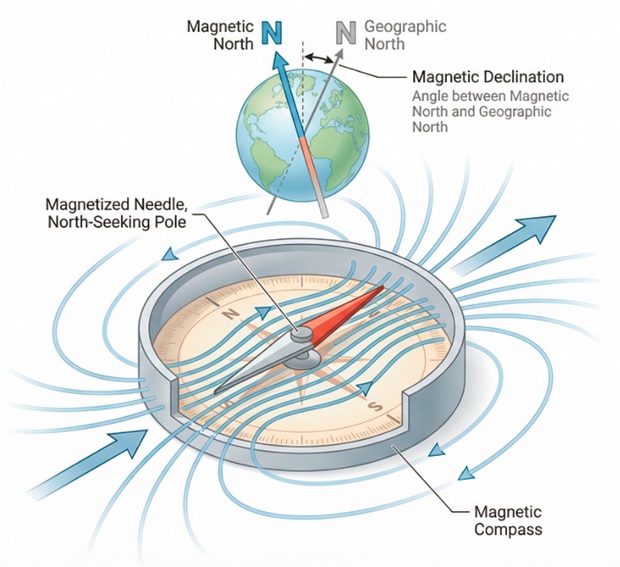
The magnetic compass, whose operation is explained in detail here, utilizes a magnetic element, typically a needle or card, that aligns with the Earth's magnetic field to indicate direction. This compass points towards the magnetic poles (see the history of the magnetic compass), which may differ slightly from true north due to magnetic declination. In contrast, the gyrocompass operates using a rapidly spinning wheel that maintains its axis of rotation, aligning itself with the Earth’s rotational poles. This allows it to point to true north, making it invaluable for precise navigation.
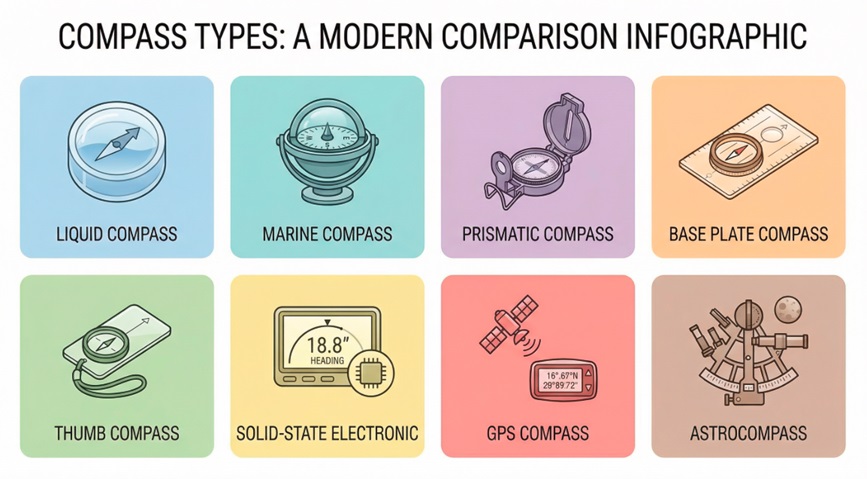
There are several major categories of navigational compasses, each designed for specific environments, accuracy needs, or technological capabilities. Below is a comprehensive table showing the most important types, their mechanisms, advantages, and limitations.
| Compass Type | Technology / Mechanism | Primary Use | Advantages | Limitations |
|---|---|---|---|---|
| Liquid Compass | Magnetized needle suspended in fluid (usually oil) | Navigation in moving environments (boats, vehicles, hiking) | Reduces oscillations, improves readability | Less accurate in high-vibration conditions |
| Marine Compass | Magnetic needle with a gimbal system and fluid for stability | Marine navigation | High stability, accurate in marine conditions | Requires adjustment for horizon in certain latitudes |
| Prismatic Compass | Magnetic needle with prism and sighting mechanism | Surveying and map-making | High precision in measurements, easy to use with direct vision | Can be challenging to use in low-visibility conditions |
| Base Plate Compass | Magnetic needle and transparent base for easy reading | Hiking, map orientation | Lightweight, transparent, great for map alignment | Reduced accuracy in areas with magnetic interference |
| Thumb Compass | Small magnetic needle designed for hand use | Orienteering races and fast-paced activities | Portable, quick to use, easy to carry | Less precise compared to larger compasses |
| Solid-State Compass | Electronic sensors such as magnetometers (magnetoresistive, fluxgate, etc.) | Electronic navigation, GPS, autonomous vehicles | High precision, no moving parts, impact-resistant | Can be affected by nearby electromagnetic interference and requires power to operate |
| Qibla Compass | Magnetic needle with city codes and degree markings | Determining the direction towards Mecca for Islamic prayers | Accurate for religious practices, easy to use while traveling | Limited to the direction of Mecca, not suitable for general navigation |
| GPS Compass | Uses GPS satellite signals to calculate direction | Navigation in vehicles, drones, and electronic devices | High precision, does not rely on a magnetic compass | Depends on satellite coverage, may fail in covered areas |
| Astrocompass | Observing celestial bodies (stars, sun) to find true north | Polar navigation and areas without magnetic reference | Does not rely on magnetic field, ideal for navigation in the Arctic or high-latitude regions | Requires celestial navigation knowledge, accurate time, and clear conditions |
Liquid Compass
A liquid compass is a type of magnetic compass in which the magnetized needle or card is enclosed in a housing filled with a damping fluid, typically a mixture of alcohol, oil, or water with antifreeze. The primary function of the liquid is to reduce the oscillations of the needle, allowing it to settle quickly and provide a stable, easy-to-read heading. This design significantly enhances readability and accuracy, especially in dynamic environments such as on moving vehicles, boats, or during handheld use.
The fluid also helps to protect the internal components from shock and vibration, prolonging the life of the instrument. Additionally, most liquid compasses are sealed to prevent the ingress of air or contaminants, making them more reliable in harsh weather conditions. They are commonly used in outdoor activities such as hiking, orienteering, and marine navigation due to their durability and ease of use.
Prismatic Compass
A prismatic compass is a type of magnetic compass commonly used in surveying and military applications due to its ability to provide highly accurate directional readings. It features a magnetic needle attached to a graduated circular ring marked in degrees, which rotates freely inside the compass housing. What sets the prismatic compass apart is its integrated prism and sighting mechanism.
The prism allows the user to simultaneously view the compass card and the distant object being sighted, enabling precise azimuth readings without needing to shift focus. This makes the prismatic compass ideal for tasks that require both navigation and measurement, such as land surveying, mapping, and field reconnaissance.
Typically, the compass is mounted on a tripod or handheld, and it includes a sighting slit or vane along with the prism for improved line-of-sight accuracy. The housing is often made of durable materials to withstand outdoor conditions and includes a mirror or reflective surface for low-light use. Thanks to its combination of mobility, precision, and ease of use, the prismatic compass remains a favored tool among professionals who need accurate directional data in the field.
Base Plate Compass
A base plate compass, also known as an orienteering compass, is a versatile and lightweight navigation tool commonly used in hiking, backpacking, and map reading. It consists of a clear, flat rectangular base—usually made of transparent plastic—that allows easy map overlay and alignment. The compass housing is mounted on this base and contains a magnetized needle suspended in liquid for smooth and stable movement.
Key features of a base plate compass include a rotating bezel (or azimuth ring) marked with degrees, orienting lines, a direction-of-travel arrow, and often a magnifying lens and ruler markings for map scaling and measurement. These elements are designed to help the user take bearings, orient maps, and navigate effectively in outdoor environments.
The transparency of the base plate allows the user to see the map underneath while aligning the compass with map features, making it ideal for land navigation and orienteering. Its simplicity, affordability, and reliability make the base plate compass a preferred choice for outdoor enthusiasts, scouts, and anyone learning basic navigation skills.
Thumb Compass
A thumb compass is a compact and highly specialized navigation tool designed primarily for competitive orienteering. Unlike traditional compasses, it is worn on the thumb—usually the left hand for right-handed individuals—allowing quick reference without interrupting movement. This hands-free design enables the user to hold a map and compass simultaneously, optimizing speed and efficiency during navigation.
The thumb compass features a magnetized needle housed in a liquid-filled capsule for stability, along with a fixed or rotating bezel marked in degrees or with simple cardinal directions. The base is ergonomically shaped to fit the curve of the thumb and often includes a map alignment edge to assist in precise map reading.
Due to its minimalist design and emphasis on speed and ease of use, the thumb compass is especially popular among orienteers, adventure racers, and trail runners. Although it may lack some of the advanced features found in surveying or marine compasses, its lightweight and intuitive functionality make it ideal for fast-paced navigation in varied terrain.
Solid-State Compass
A solid-state compass is an advanced electronic navigation instrument that uses magnetoresistive, fluxgate, or Hall-effect sensors to detect magnetic fields, rather than relying on a physical magnetic needle. These sensors measure the Earth's magnetic field along multiple axes (typically three), allowing the device to determine heading with high precision and speed.
Unlike traditional compasses, solid-state compasses have no moving parts, which makes them highly durable and resistant to shock and vibration. They are often integrated into electronic devices such as smartphones, drones, GPS units, and wearable tech, and are typically combined with accelerometers and gyroscopes to form an Inertial Measurement Unit (IMU). This integration allows for tilt compensation, enabling accurate heading data even when the device is not held level.
Solid-state compasses offer digital output, which can be directly processed by microcontrollers or navigation software. Their compact size, robustness, and compatibility with modern technology make them ideal for applications in robotics, aviation, marine navigation, and consumer electronics.
Qibla Compass
A Qibla compass is a specialized magnetic compass used by Muslims to determine the direction of the Kaaba in Mecca, which is the qibla—or direction—they face during daily prayers. This compass is tailored for Islamic religious practices and is widely used during travel or in regions where qibla orientation is not obvious.
The Qibla compass typically combines a traditional magnetic needle with a rotating dial marked with degrees and city codes or reference numbers. These codes correspond to different cities or regions and indicate the qibla direction relative to magnetic north. To use it, the user sets the dial to the number that matches their city (usually found in an accompanying index or guidebook), and the compass then shows the direction to Mecca.
Modern versions may include digital displays, GPS functionality, or smartphone integration for automatic location detection and qibla calculation. Whether analog or digital, the Qibla compass is an important devotional tool that blends spiritual observance with practical navigation.
GPS Compass
A GPS compass, also known as a satellite-based compass, determines direction not by sensing the Earth's magnetic field, but by calculating movement and orientation using signals from multiple GPS satellites. Unlike a magnetic compass, it does not rely on a magnetized needle or magnetic sensors. Instead, it determines heading by comparing position changes over time or by using dual-antenna setups that detect orientation even when stationary.
High-precision GPS compasses, often used in marine, aviation, surveying, and autonomous vehicle applications, can deliver real-time heading data with impressive accuracy—especially when using differential GPS (DGPS) or Real-Time Kinematic (RTK) positioning for error correction. They are immune to magnetic interference and do not require calibration like traditional compasses.
Some handheld GPS units and smartphones include a "GPS compass" mode, which works best when the user is in motion. When stationary, these devices may rely on built-in digital magnetometers to estimate direction.
While GPS compasses are highly accurate and reliable in open-sky environments, they can be less effective in areas with poor satellite visibility, such as dense forests, urban canyons, or indoors.
Astrocompass
An astrocompass is a precision navigational instrument used to determine true north by observing celestial bodies such as the Sun or stars, rather than relying on the Earth's magnetic field. It is especially useful in regions where magnetic compasses are unreliable, such as near the poles, or where magnetic anomalies are present.
The astrocompass consists of a base with adjustable latitude and declination settings, a sighting mechanism (often with a telescope or peep sights), and a time scale. To use it, the navigator inputs the exact time, date, and location, then aligns the sight with a known celestial object. Based on astronomical data, the instrument indicates the direction of true north.
Astrocompasses were widely used in aviation and polar exploration before the widespread use of GPS. They remain useful in scenarios requiring non-magnetic navigation or as a backup system. However, using one requires knowledge of celestial navigation and access to accurate ephemeris data.
Which Compass Type Should You Choose?
Selecting the right compass depends on your environment and navigation needs:
- Hiking, trekking, or map reading: Base plate compass — learn more in our compass facts section
- Orienteering or fast navigation: Thumb compass
- Marine navigation: Marine compass or GPS compass
- Aviation, polar regions, or high-latitude surveying: Astrocompass or gyrocompass
- Robotics, drones, or smartphones: Solid-state electronic compass
- Religious direction finding: Qibla compass
This quick guide helps match each compass type to its ideal use case, ensuring accurate and reliable navigation in any condition. For readers interested in how these instruments evolved, explore the complete history of compasses.

Learn more about compasses: